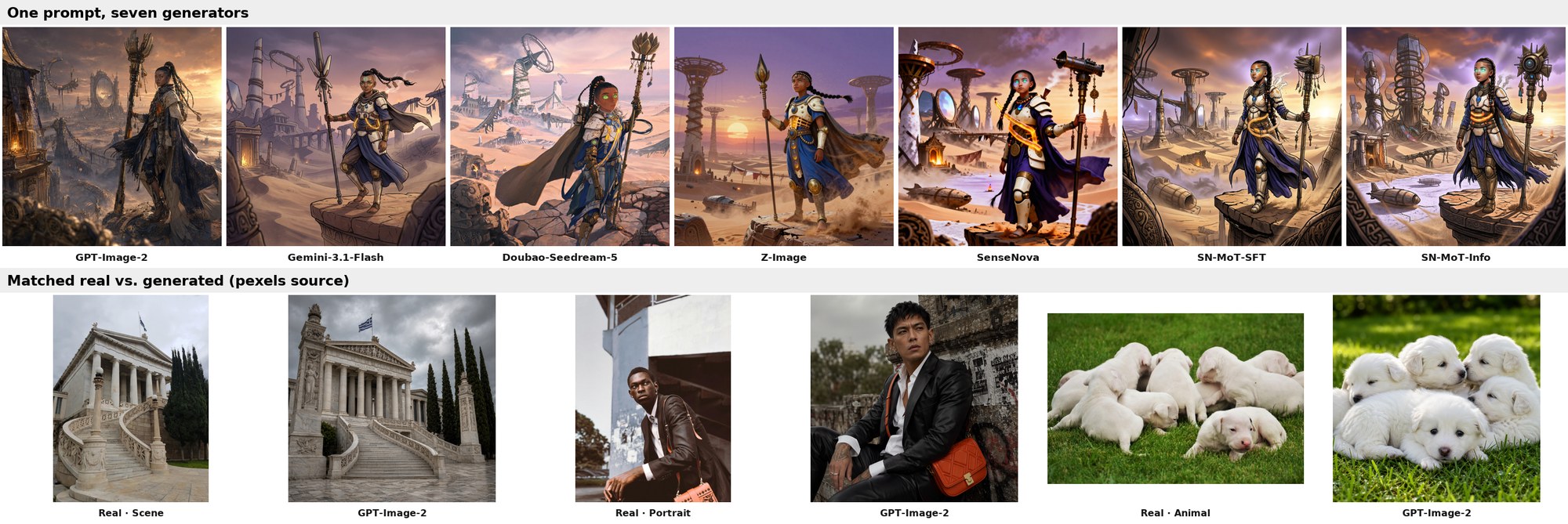
pexels source) — GenSpectrum's two signatures: cross-model alignment
and matched real/generated pairs.
The rapid progress of text-to-image (T2I) generation is increasingly driven by frontier proprietary systems, yet public resources for systematically studying their behavior remain limited. Existing corpora often focus on a single generator, cover outdated models, or lack prompt-aligned real images, which makes it hard to compare modern generators or to analyze why they succeed and fail. We present GenSpectrum, a large-scale prompt-aligned dataset and benchmark for evaluating frontier T2I models. The first release contains 9,817 prompts rendered through eight state-of-the-art generators (GPT-Image-2, Gemini-3.1-Flash, Doubao-Seedream-5.0, Z-Image, Qwen-Image-2.0-Pro, and three SenseNova variants), yielding 72,523 images (70,525 generated and 1,998 real). All samples are organized under a unified schema with prompt metadata and content-domain annotations.
Because every prompt is aligned across models — and, for the pexels source,
against a real photograph — GenSpectrum is a general testbed for studying modern
generators: cross-model comparison, prompt following and in-image text rendering, generator
attribution, and AI-generated image detection, among others. As an initial study we benchmark
16 detectors and find that no single detector handles every generator: the strongest,
DDA, reaches 0.87 mean balanced accuracy, while detectors that look solved on older
generators — such as SAFE — fall to near chance on the two newest, Gemini-3.1-Flash and
Doubao-Seedream-5.0. We release GenSpectrum as the first version of a living dataset and
benchmark.
The prompt is the unit of alignment — the same content compared side-by-side across all generators.
GPT-Image-2, Gemini-3.1-Flash, Doubao-Seedream-5.0, Z-Image, Qwen-Image-2.0-Pro & 3× SenseNova.
1,998 real photographs paired with images generated from their captions for fair forensic study.
9 domains under one schema; detection ships first, with more downstream tasks to come.
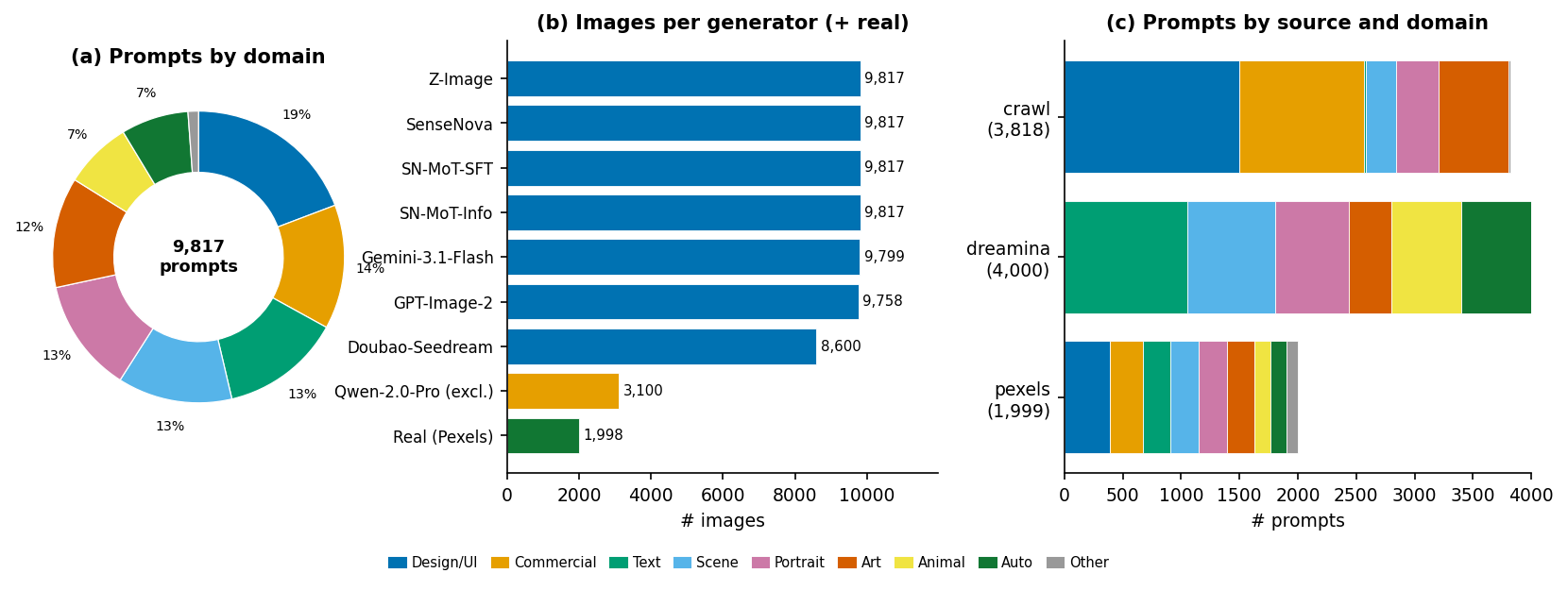
9,817 prompts from three complementary sources — community API galleries (crawl),
design-platform prompts (dreamina), and real-photo captions (pexels) —
spanning nine content domains.
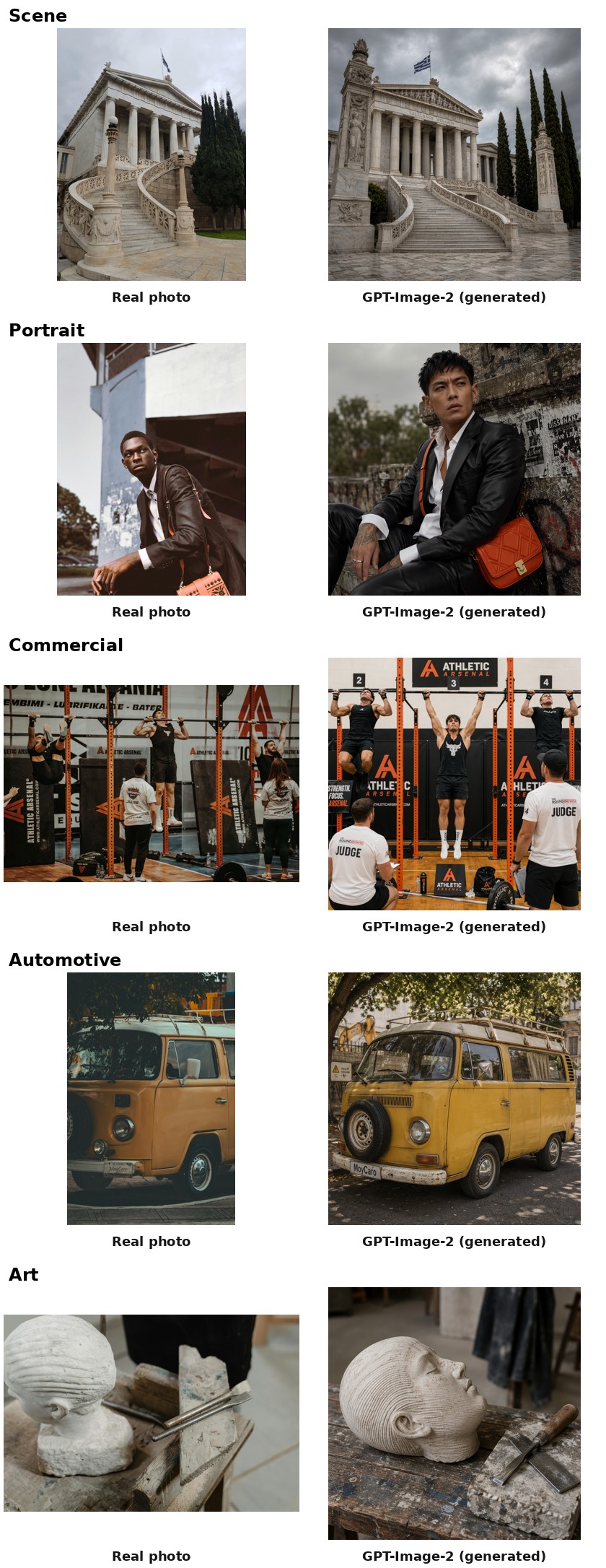
Pick a domain, choose a prompt, and compare how every generator renders it — side by side.
Where a real reference photo exists (pexels), it is shown first.
A curated, self-contained subset of the full corpus.
The pexels source starts from a real photograph, captions it with a
vision–language model, and feeds that caption back to a generator — yielding an image aligned to
a genuine reference photo and enabling a class-balanced real-versus-generated protocol.
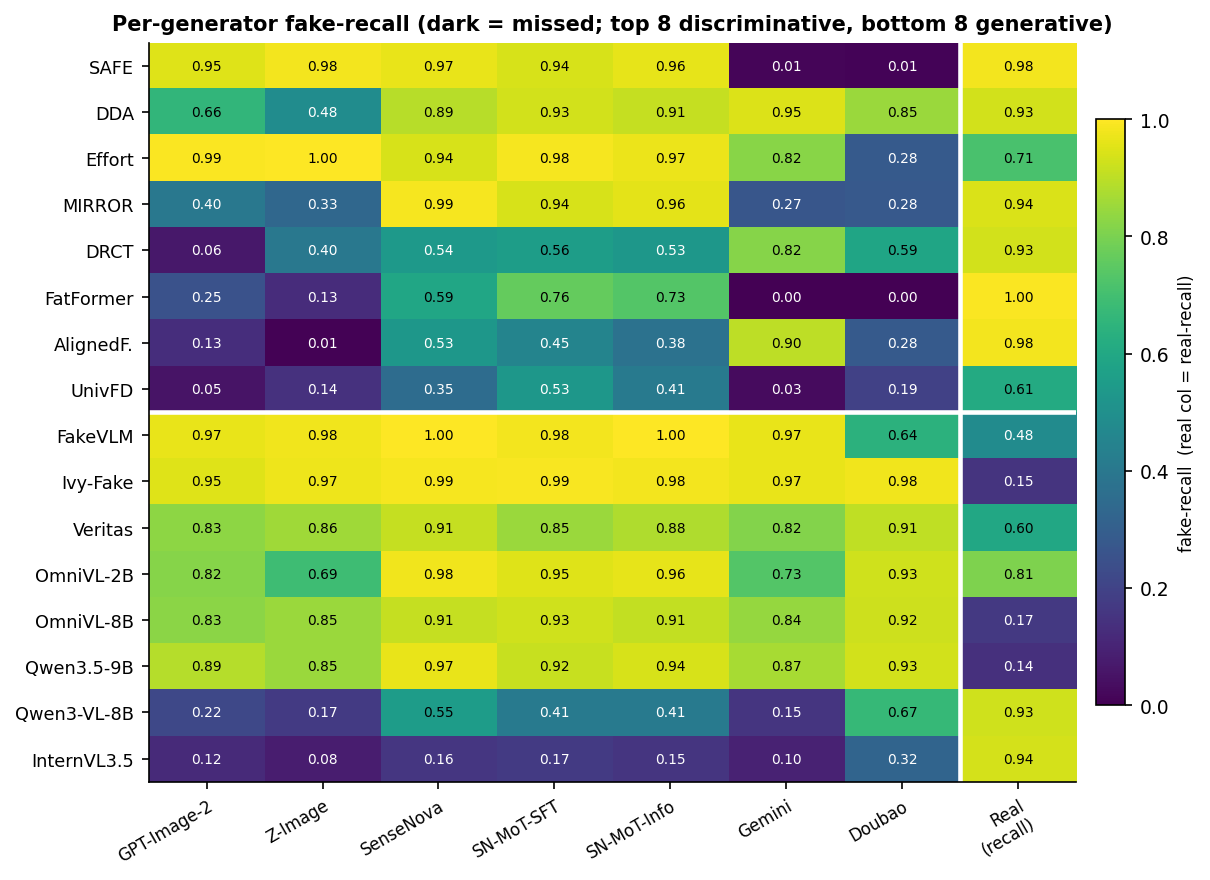
Our first downstream task. 16 off-the-shelf detectors (8 discriminative + 8 generative) are
evaluated on prompt-matched pexels pairs, one generator at a time.
No single detector is robust across all generators.
| Detector | Type | Mean BAcc ↑ |
|---|---|---|
| DDA | disc | 0.871 |
| SAFE | disc | 0.837 |
| OmniVL-Guard-2B | gen | 0.835 |
| Effort | disc | 0.784 |
| MIRROR | disc | 0.769 |
| Veritas | gen | 0.733 |
| DRCT | disc | 0.715 |
| FakeVLM | gen | 0.708 |
SAFE is best on the older five generators (0.96–0.98) yet collapses to ~0.50 on the two newest, while keeping 0.98 real-recall. See the paper for the full table.
@misc{yan2026genspectrum,
  title        = {GenSpectrum: A Multi-Model, Multi-Task Text-to-Image Corpus},
  author       = {Yan, Juncheng and Li, Yifei and Zhang, Yanran and Zheng, Yu and
                  Zhang, Borui and Fu, Bin and Qiao, Yu and Lu, Jiwen},
  year         = {2026},
  howpublished = {Preprint / Technical Report},
  url          = {https://github.com/JoeLeelyf/GenSpectrum}
}